

The Internal Costs of External Service: Why Low-Cost Apps and Manual Check-Ins Cost More Than Managed Monitoring

Estimated reading time: 10 minutes
Direct answer
The real monthly cost of lone worker monitoring systems is not the monthly software subscription. It is the internal time required to manage check-ins, missed responses, alarms, escalation, after-hours coverage, and documentation which multiply the total cost of ownership.
Manual check-ins, low-cost automated lone worker apps, and basic call-centre check-ins may look inexpensive on paper. But if supervisors, managers, dispatchers, or emergency contacts still need to monitor alerts and coordinate the response, the employer is still carrying much of the operational cost.
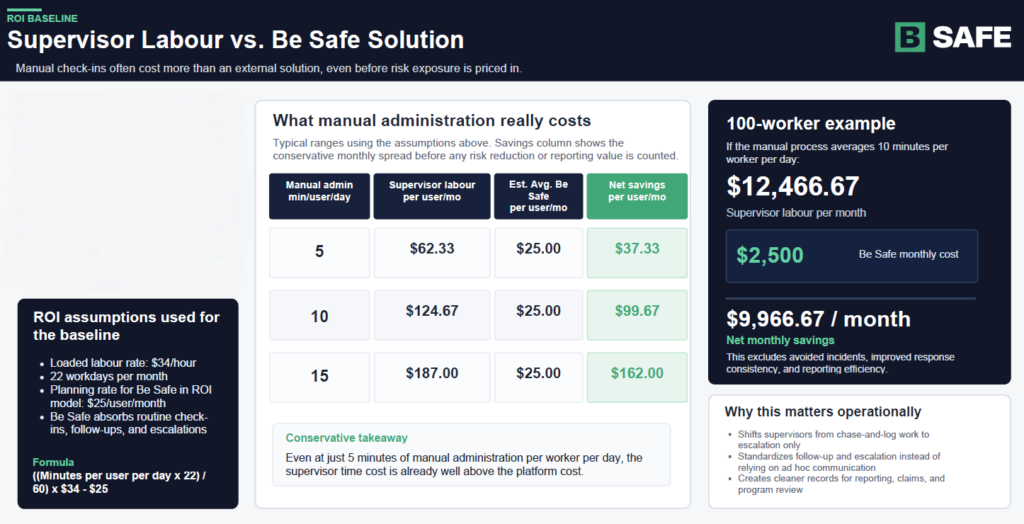
For many organizations, Be Safe can be less expensive than managing lone worker safety internally once internal administration exceeds roughly two minutes per worker per day, based on the ROI assumptions in the attached Be Safe model: $34 loaded labour rate, 22 workdays per month, and a $25 per-user planning cost.
Lone worker safety is a response process, not just a check-in app
A working-alone program is not simply about reminding workers to press a button.
The real test is what happens when a worker does not check in, presses a panic button, loses contact, or needs assistance after hours.
We know that Canadian working-alone requirements are built around contact, response, and procedure. WorkSafeBC states that employers must have procedures to ensure the well-being of workers who work alone or in isolation, and that lone workers must be able to get assistance if injured or in an emergency. Alberta’s OHS Code requires an effective communication system for workers working alone, including regular contact by the employer or designate at intervals appropriate to the hazard. CCOHS also recommends a check-in procedure, regular contact, and training for both the lone worker and the person responsible for responding if there is concern.
That is why the ROI conversation cannot stop at “what does the app cost?”
The better question is:
Who owns the response when something goes wrong?
The visible price vs. the real cost of a lone worker monitoring solution
A subscription price is visible. Internal labour is not.
A manual program may have no software invoice, but supervisors still spend time calling workers, sending texts, recording check-ins, following up on missed responses, and escalating concerns.
A low-cost automated app may reduce some routine check-in work, but it can still push alerts to internal staff. If the organization is still responsible for monitoring alerts, responding after hours, calling the worker, escalating to contacts, and documenting the result, the cost has not disappeared. It has simply moved inside the payroll line.
A basic call centre may handle calls or texts, but unless it is purpose-built for lone worker safety, the employer may still need to manage procedures, escalation logic, worker schedules, supervisor reporting, emergency contacts, and documentation.
The real cost of a lone worker safety program includes:
| Cost area | Why it matters |
| Routine check-in administration | Repeated daily check-ins consume supervisor or dispatcher time. |
| Missed check-in follow-up | One missed response can trigger multiple calls, texts, and internal escalations. |
| Alarm handling | Panic, fall, no-motion, or overdue activity alerts require a timely response. |
| After-hours coverage | Someone must be responsible when alerts occur outside normal business hours. |
| Escalation management | Contacts must be reached in the right order, and the process must be documented. |
| Recordkeeping | Logs matter for audits, incident reviews, claims, and program accountability. |
| Program maintenance | Schedules, contact lists, procedures, and worker assignments must stay current. |
| Supervisor interruption | Safety admin pulls supervisors away from operational work. |
This is where the cheapest-looking option can become the most expensive operationally.
Manual supervisor check-ins: no invoice, but high labour cost
Manual check-ins usually look inexpensive because there is no vendor subscription. A supervisor calls or texts the worker, waits for the reply, records the result, and follows up if the worker does not respond.
For a small number of low-risk workers, this may be manageable. But at scale, the model breaks down quickly.
Using the Be Safe ROI baseline:
Lone Worker Monitoring – internal labour cost per worker =
(minutes per worker per day × 22 workdays ÷ 60) × $34/hour
| Manual administration time | Internal labour cost per worker/month |
| 2 minutes/day | $24.93 |
| 5 minutes/day | $62.33 |
| 10 minutes/day | $124.67 |
| 15 minutes/day | $187.00 |
Assume an average $25 per-user, per-month Be Safe cost, the break-even point is roughly two minutes per worker per day.
For a 100-worker program:
| Manual administration time | Internal labour cost/month | Be Safe cost/month | Estimated monthly savings |
| 5 minutes/day | $6,233 | $2,500 | $3,733 |
| 10 minutes/day | $12,467 | $2,500 | $9,967 |
| 15 minutes/day | $18,700 | $2,500 | $16,200 |
The core issue is not whether supervisors are capable. They are. The issue is that manual check-ins and supervisor-managed escalations turn safety monitoring into repetitive administrative work that competes with operations, field support, customer issues, scheduling, and incident management.
Low-cost automated lone worker apps: useful automation, but can cause chaos
Automated lone worker apps can be valuable. They can prompt workers to check in, capture GPS location, send missed check-in alerts, and generate activity records.
The problem is not automation. The problem is automation without response ownership.
Several providers publicly describe models where organizations can manage alerts internally or avoid a call centre. One service specifically promotes a “fully automated” model with “no call center required.” They also describe automated lone worker check-ins where missed check-ins generate notifications and a panic emergency can be signaled.
A second service provider publicly states that its 24/7 live monitoring service is optional, giving organizations the freedom to choose when to use live monitoring and when to use their own people instead. They also list an app model at as low as $8 per user per month in a public comparison article, with GPS monitoring, updates, reports, phone/SMS/app contact to monitors, and satellite-device compatibility.
Those models may be appropriate for some employers. But from an ROI standpoint, the key question is whether the subscription includes a managed response or simply routes alerts back to internal staff.
If internal managers still need to handle alerts, the organization still needs to answer:
| Operational question | Why it affects cost |
| Who receives alerts at 2:00 a.m.? | After-hours response is often underpriced or unmanaged. |
| What happens if the first contact does not answer? | Escalation must be reliable, not improvised. |
| Who calls the worker? | Each missed check-in creates active labour. |
| Who decides whether to escalate? | Delayed decisions create risk and uncertainty. |
| Who contacts emergency services? | A notification is not the same as emergency response. |
| Who documents the outcome? | Records matter for compliance and incident review. |
| Who updates schedules and emergency contacts? | Outdated contact data weakens the program. |
This is the hidden cost of automated-only monitoring.
An $8 app plus 10 minutes of internal labour is not an $8 solution. Using the Be Safe baseline, 10 minutes of internal administration costs approximately $124.67 per worker per month before the app subscription is even added.
Basic call-centre check-ins: outsourced calls are not always a complete safety program
A call centre can reduce supervisor workload by placing check-in calls or receiving worker updates. For some organizations, that may be better than fully manual monitoring.
But a general call centre is not automatically equivalent to a complete lone worker safety platform.
General call centre outsourcing is commonly priced by minute or agent hour. Twilio’s 2026 call centre pricing guide states that inbound centres typically charge $0.50 to $1.75 per minute, while outbound centres usually run $10 to $50 per hour, depending on complexity and location.
A simple two-minute check-in per worker per day across 22 workdays equals 44 minutes per worker per month.
At $0.50 to $1.75 per minute, that creates an estimated cost of:
$22 to $77 per worker per month
That may still exclude exception handling, program configuration, emergency escalation design, schedule maintenance, supervisor dashboards, GPS context, audit reporting, and internal management time.
The problem is simple: a call centre may outsource the call, but not necessarily the full safety workflow.
Risks of a Service vs. a Solution
A lone worker program does not end when an alert is sent. The real risk begins when the organization has to prove what happened, when it happened, who responded, and whether the response followed the required procedure.
This is where a basic service can create exposure. A low-cost app or call/SMS check-in provider may send notifications, but if internal supervisors are still responsible for escalation, the audit trail often becomes fragmented. One person may call the worker, another may text an emergency contact, a manager may leave a voicemail, and someone else may update a spreadsheet later. In a serious incident, that is a weak and difficult-to-defend record.
Canadian guidance reinforces the importance of documented procedure and recorded contact. WorkSafeBC guidance expects written procedures for checking the well-being of workers working alone or in isolation, including check intervals, what to do if the worker cannot be contacted, emergency rescue provisions, a designated contact person, and recorded results. Alberta’s OHS Code requires an effective communication system with regular contact by the employer or designate at intervals appropriate to the hazard. CCOHS also recommends a check-in procedure, regular contact, training for the responder, and review of incidents or near misses where working alone increased the severity of the situation.
The issue is not paperwork. It is defensibility.
After a genuine health and safety incident, an employer may need to show that it had a reasonable process, followed that process, and responded in a timely way. If the timeline is scattered across phone records, text messages, emails, handwritten notes, and supervisor memory, reconstructing the event becomes difficult and potentially damaging.
A complete lone worker safety solution should centralize the record. It should capture check-ins, missed check-ins, alerts, timestamps, escalation attempts, operator actions, worker contact, supervisor visibility, and resolution notes in one auditable location.
That distinction matters.
A service may notify someone that there is a problem. A solution helps prove what happened next.
Managed lone worker monitoring: the stronger ROI model
Managed monitoring changes the cost structure because it removes much of the repetitive internal work.
The value is not just software. The value is that missed check-ins, alarms, escalation workflows, and records are handled through a defined process rather than being pushed back onto supervisors.
Other managed providers position this clearly. Aware360 describes SafetyAware as creating alerts from missed check-ins, overdue hazard timers, falls, or SOS events, with a live 24/7 monitor responding in under 60 seconds. CheckMate by ProTELEC states that its Safe Alone App includes 24/7 monitoring, GPS tracking, panic button, dashboard access, audit reports, no setup fees, and no monitoring surcharges, with public pricing shown at $19.25 per worker/month for 5+ users.
Be Safe belongs in this managed-monitoring category, with a practical advantage for employers that want a simple smartphone-first solution backed by 24/7 human monitoring.
The ROI case is straightforward:
Be Safe reduces the total monthly cost of managing lone worker safety programs by removing routine check-in administration, reducing supervisor interruption, standardizing escalation, and improving documentation.
The buyer’s real comparison
The buying decision should not be framed as:
“Which app has the lowest monthly price?”
It should be framed as:
“Which option gives us the lowest total cost while improving response consistency?”
| Option | Visible cost | Hidden cost |
| Manual supervisor check-ins | Low or none | Supervisor time, inconsistent records, missed follow-ups, after-hours disruption |
| Low-cost automated app | Low subscription | Internal alert response, escalation handling, false alarm management, after-hours responsibility |
| Basic call centre | Per-minute or service fee | Limited safety workflow, separate reporting, internal program administration |
| Hardware-centric system | Higher device/service cost | Hardware deployment, device management, long-term device/service commitment |
| Be Safe managed monitoring | Predictable subscription | Lower internal administration burden and cleaner escalation workflow |
For most organizations, the strongest financial lever is not the subscription price. It is reducing the time internal staff spend managing the system.
Why Be Safe Has a Lower Total Cost of Ownership (TCO)
Be Safe’s advantage is operational simplicity.
Workers use the Be Safe app for check-ins, panic alerts, and shift activity. Supervisors gain visibility without manually chasing every worker. Missed check-ins and alerts follow a structured monitoring process. Records are generated through the platform rather than scattered across calls, texts, spreadsheets, and informal notes.
That matters because lone worker safety administration is easy to underestimate.
Five minutes per worker per day sounds minor. Across 100 workers, it becomes more than $6,200 per month in supervisor labour using the Be Safe ROI baseline.
Ten minutes per worker per day becomes almost $12,500 per month.
Fifteen minutes per worker per day becomes approximately $18,700 per month.
Assuming a $2,500/month Be Safe cost for 100 workers, the savings can be substantial even before factoring in better escalation, fewer interruptions, cleaner reporting, and reduced after-hours burden.
Conclusion
The cheapest lone worker safety option is not always the lowest-cost program.
Manual check-ins hide the cost in supervisor labour.
Low-cost automated apps can hide the cost in internal alert response.
Basic call centres can hide the cost in per-minute activity and incomplete safety workflows.
Hardware-centric systems may be essential for some environments, but can be more than many workers require.
Be Safe is designed to reduce the total cost of managing lone worker safety by combining simple worker check-ins, 24/7 human monitoring, supervisor visibility, structured escalation, and reporting into one practical program.
The business case is direct:
If your organization spends more than two minutes per worker per day managing lone worker check-ins, missed responses, records, or escalations, Be Safe is likely already less expensive than managing the process internally.